A Short History of Sigirya
[Click arrow at bottom to
proceed to Architectural Design]
History: A Tale of Three Cities
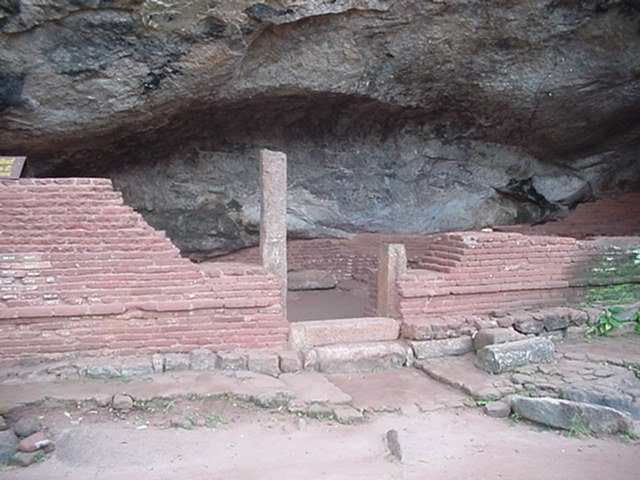 Sigirya's
legacy stretches back into prehistory; it boasted human
settlements as early as the Mesolithic period, and can
claim continuous occupation for a period of over five
thousand years. The rock outcroppings at the base of the huge
rock formed caves in which people lived. These caves became
monastic cells during the fifth century B.C. with the
establishment of a Buddhist settlement on the rock-strewn
western and northern slopes of the hills surrounding the rock.
Sigiriya grew from a series of rock shelters into an urban
center in the 5th century A.D., during the reign of King
Kasyapa, the man who transformed the mountain into a
spectacular kingdom. There seem to be three distinct theories
about Kasyapa's life, his aspirations, and his role in the
development of the Sigiriya complex.
Sigirya's
legacy stretches back into prehistory; it boasted human
settlements as early as the Mesolithic period, and can
claim continuous occupation for a period of over five
thousand years. The rock outcroppings at the base of the huge
rock formed caves in which people lived. These caves became
monastic cells during the fifth century B.C. with the
establishment of a Buddhist settlement on the rock-strewn
western and northern slopes of the hills surrounding the rock.
Sigiriya grew from a series of rock shelters into an urban
center in the 5th century A.D., during the reign of King
Kasyapa, the man who transformed the mountain into a
spectacular kingdom. There seem to be three distinct theories
about Kasyapa's life, his aspirations, and his role in the
development of the Sigiriya complex.
KASYAPA, THE EVIL
SON: A MORALITY TALE
 The
most-oft told story paints Kasyapa as a parricidal monster.
Kasyapa, the son of the king by a consort, killed his father,
Dhatusena I (459-477), by imprisoning him and entombing him
behind a wall while he was still alive in order to gain the
throne. Driven into exile, his half-brother, the crown prince
Moggallana, retreated to India and assembled an army to avenge
his father's death. Kasyapa prepared for this eventuality by
transforming the Sigiriya into a impenetrable complex. It was
all for naught for, according to the legend, Kasyapa was
lured from the rock by Moggallana. Enroute to do battle
Kasyapa's elephant changed direction, sensing a swamp; his
followers interpreted this as a retreat, and Kasyapa found
himself alone in the face of an advancing army. Rather than
facing death at the hands of his half-brother he beheaded
himself, bringing this morality tale to its fitting
conclusion. Click here
to learn more about this view
The
most-oft told story paints Kasyapa as a parricidal monster.
Kasyapa, the son of the king by a consort, killed his father,
Dhatusena I (459-477), by imprisoning him and entombing him
behind a wall while he was still alive in order to gain the
throne. Driven into exile, his half-brother, the crown prince
Moggallana, retreated to India and assembled an army to avenge
his father's death. Kasyapa prepared for this eventuality by
transforming the Sigiriya into a impenetrable complex. It was
all for naught for, according to the legend, Kasyapa was
lured from the rock by Moggallana. Enroute to do battle
Kasyapa's elephant changed direction, sensing a swamp; his
followers interpreted this as a retreat, and Kasyapa found
himself alone in the face of an advancing army. Rather than
facing death at the hands of his half-brother he beheaded
himself, bringing this morality tale to its fitting
conclusion. Click here
to learn more about this view
KASYAPA:
REALIZING THE DREAMS OF DHATUSENA I
 However
more recently other theories have been advanced. One disputes
Kasyapa's patricide, arguing that he inadvertently
killed his father in battle, deceived by his
half-brother. This version paints Kasyapa in an entirely
different light; he is viewed as a brilliant designer and
devoted son. According to this view, his decision to abandon
his father's capital at Anuradhapura arose from the desire to
complete his father's dream, to build a heavenly palace on the
order of the mythical Tibetan palace of the god of wealth,
Kuvera. In so doing Kasyapa would assume the highest mantle of
power to which a secular leader at that time could aspire;
Sigiriya is in essence a completion of his father's dream, and
Kasyapa is seen as a faithful son.
Click here to learn more
However
more recently other theories have been advanced. One disputes
Kasyapa's patricide, arguing that he inadvertently
killed his father in battle, deceived by his
half-brother. This version paints Kasyapa in an entirely
different light; he is viewed as a brilliant designer and
devoted son. According to this view, his decision to abandon
his father's capital at Anuradhapura arose from the desire to
complete his father's dream, to build a heavenly palace on the
order of the mythical Tibetan palace of the god of wealth,
Kuvera. In so doing Kasyapa would assume the highest mantle of
power to which a secular leader at that time could aspire;
Sigiriya is in essence a completion of his father's dream, and
Kasyapa is seen as a faithful son.
Click here to learn more
SIGIRIYA: THE
BUDDHIST CREATION
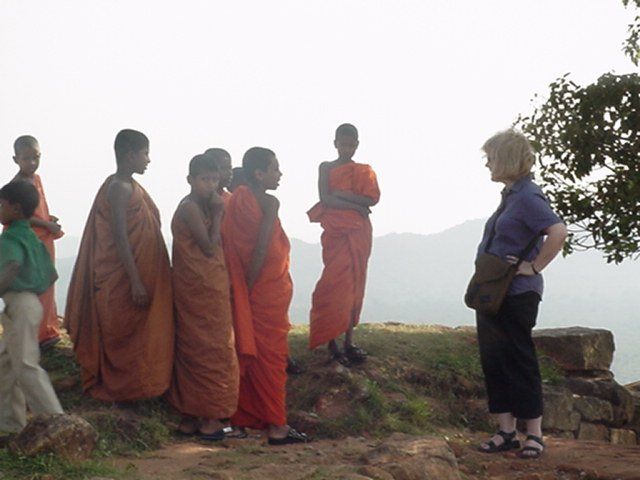 Still
another version casts doubt on both theories. First, it
maintains that it is unlikely that Sigiriya was built as a
fortress, for it could be starved out by a siege in less than
six months. And it also challenges the the heavenly
palace theory, arguing that given the weather conditions and
the relative brevity of Kasyapa's tenure at Sigiriya, it is
most likely the grand design was executed over a much longer
period of time. This view maintains the development of
Sigiriya was accomplished by and large by the monks who
occupied the mountain before and after Kasyapa, the gradual
evolution of a religious and aesthetic vision. Click here to
learn more about this view.
Click here to learn more
Still
another version casts doubt on both theories. First, it
maintains that it is unlikely that Sigiriya was built as a
fortress, for it could be starved out by a siege in less than
six months. And it also challenges the the heavenly
palace theory, arguing that given the weather conditions and
the relative brevity of Kasyapa's tenure at Sigiriya, it is
most likely the grand design was executed over a much longer
period of time. This view maintains the development of
Sigiriya was accomplished by and large by the monks who
occupied the mountain before and after Kasyapa, the gradual
evolution of a religious and aesthetic vision. Click here to
learn more about this view.
Click here to learn more
While we may never know the true story of
Kasyapa and his contributions to Sigiriya, it is clear that
by the time of his death in 495 A.D., most of the
architectural details which make Sigiriya a wonder of the
ancient world were in place. Let us now turn our attention
to those details.
On to Architectural
Design

Return to Sigiriya Main
Page