
Diwan-I-Khas
Although the term "Diwan-I-Khas" refers to a hall
of private audiences, exactly what type of audiences were convened here by Akbar
remains a mystery. Located at the northeast corner of the royal complex, the
Diwan-I-Khas has been described in guide books as the Emperor's private audience
chamber, owing to presence of a massive pillar with a central platform and
attached diagonal galleries. According to this interpretation, Akbar used to sit
on the central chamber while the four galleries were occupied by
 his
ministers. However, these galleries were so narrow that they could never
accommodate all ministers of the court, casting practical doubt on this
interpretation. A more plausible belief is that this building was a store house
for the imperial hoard of gems and jewels, and it has been reported that Akbar
often sat on its central pillar not to conduct affairs of
state, but to inspect his jewels. Adding further support to this idea is the
fact that it is known that Akbar had three separate treasuries, two for gold and
silver and one for the gems and jewels, which were close to each other. Appropriately, the
Diwan-I-Khas stands in the treasury precinct next to the gold and silver
treasure house, the Ankh Michauli. The exterior of the Diwan-I-Khas is
very representative of the buildings of Fatehpur Sikri, with its distinctive
cupolas. The brackets at the top of the first level support a walkway with
delicate latticework rails. Ornate engraving decorates the exterior. The
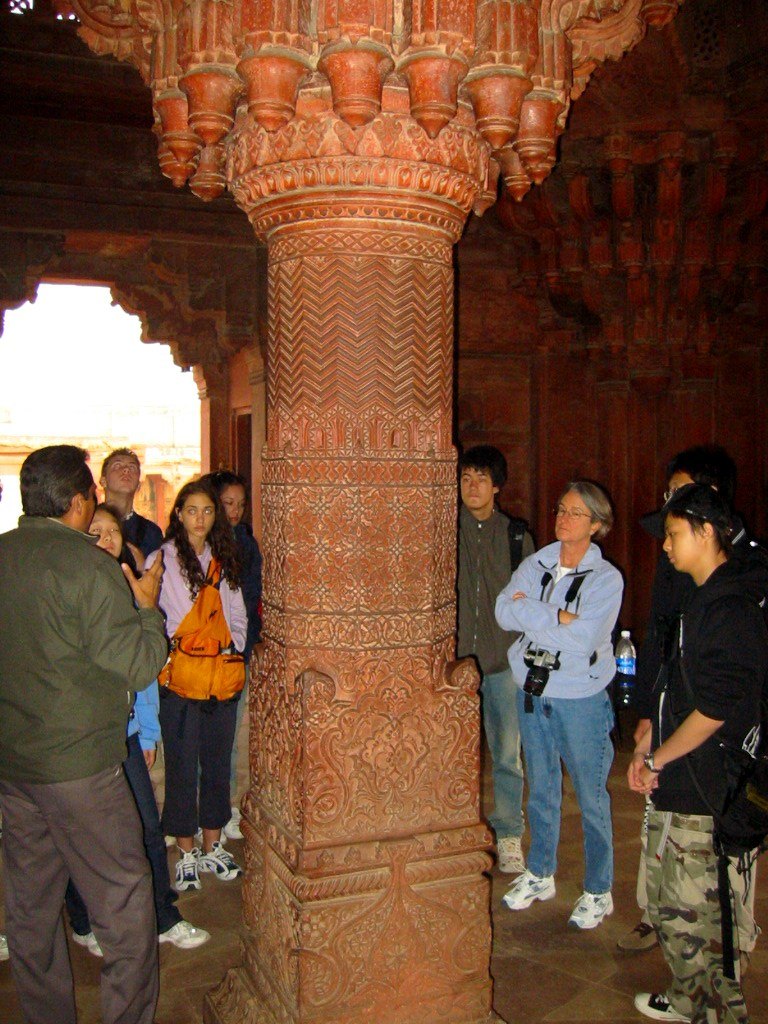
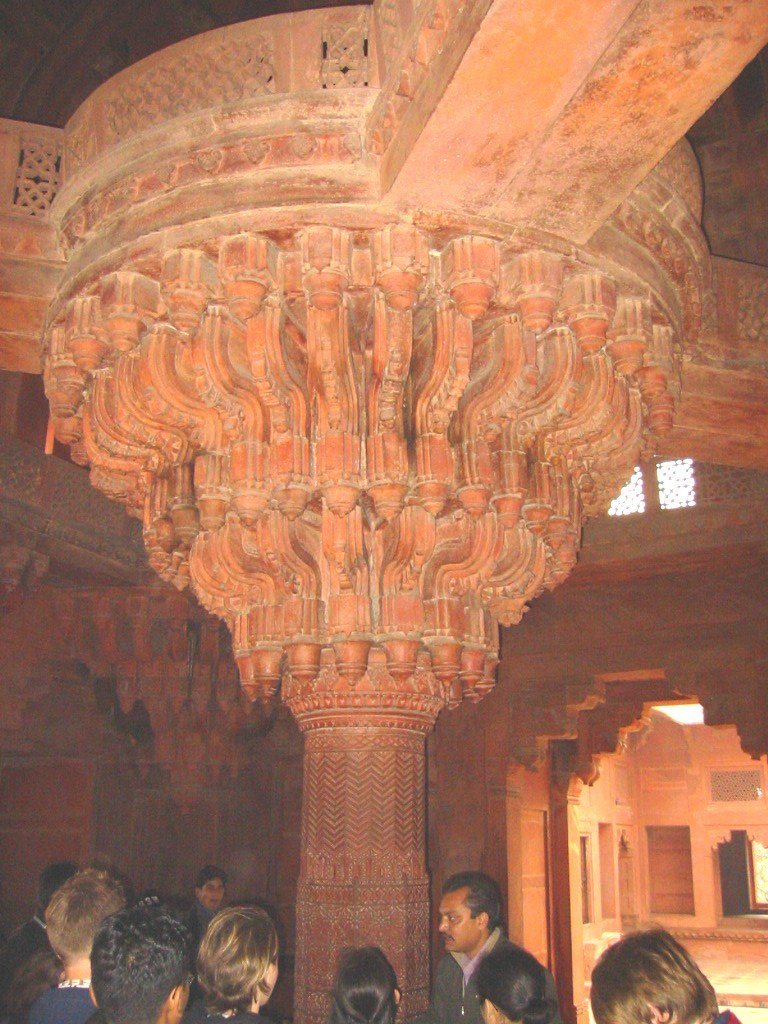
interior is dominated by a single pillar, connected to the corners of the room
by three walkways. The central column reflects the theology of Akbar's universal
religion; the carvings from the bottom to the top display iconography from
Islam, Christianity, and Hinduism, respectively. The photo to the right shows
the religious motifs carved on the central pillar, while the photo to the right
shows a close-up of the top of the pillar, with the three walkways that connect
the pillar to the sides of the Diwan-I-Khas.
his
ministers. However, these galleries were so narrow that they could never
accommodate all ministers of the court, casting practical doubt on this
interpretation. A more plausible belief is that this building was a store house
for the imperial hoard of gems and jewels, and it has been reported that Akbar
often sat on its central pillar not to conduct affairs of
state, but to inspect his jewels. Adding further support to this idea is the
fact that it is known that Akbar had three separate treasuries, two for gold and
silver and one for the gems and jewels, which were close to each other. Appropriately, the
Diwan-I-Khas stands in the treasury precinct next to the gold and silver
treasure house, the Ankh Michauli. The exterior of the Diwan-I-Khas is
very representative of the buildings of Fatehpur Sikri, with its distinctive
cupolas. The brackets at the top of the first level support a walkway with
delicate latticework rails. Ornate engraving decorates the exterior. The
interior is dominated by a single pillar, connected to the corners of the room
by three walkways. The central column reflects the theology of Akbar's universal
religion; the carvings from the bottom to the top display iconography from
Islam, Christianity, and Hinduism, respectively. The photo to the right shows
the religious motifs carved on the central pillar, while the photo to the right
shows a close-up of the top of the pillar, with the three walkways that connect
the pillar to the sides of the Diwan-I-Khas.